Sunday, 23 October 2016

Saturday, 22 October 2016
References
- Appignanesi, R., Garratt, C., Sardar, Z. & Curry, P. 2004, Introducing postmodernism, [New] edn, Icon, Thriplow.
Friday, 14 October 2016
Week 2 Modernist Narrative
Modernism crosses over all creative approaches, from film, to art to literature. As science was developing, along with urbanisation and industrialisation, people also began to change. they began to question their undoubted belief in God and Religion which had been deeply set by the Catholic Church and their lack of religion. Characters such as Freud and Darwin began challening intellectual hegemony (leader or dominance over social groups, and all of the values that were the foundations of these very people's lives.
The Industrial Revolution was where huge populations move to cities where there then had access to education.
The invention of photography had an enormous effect on the approach people had to art. Many new forms of Art and 'isms' such as 'Cubism,' and 'Surrealism' were established. The cubist movement featured painters who tried to capture many perspectives such as Cezanne. He tried in a more honest way to visualise objects in a 3D distortions.

The Industrial Revolution was where huge populations move to cities where there then had access to education.
The invention of photography had an enormous effect on the approach people had to art. Many new forms of Art and 'isms' such as 'Cubism,' and 'Surrealism' were established. The cubist movement featured painters who tried to capture many perspectives such as Cezanne. He tried in a more honest way to visualise objects in a 3D distortions.
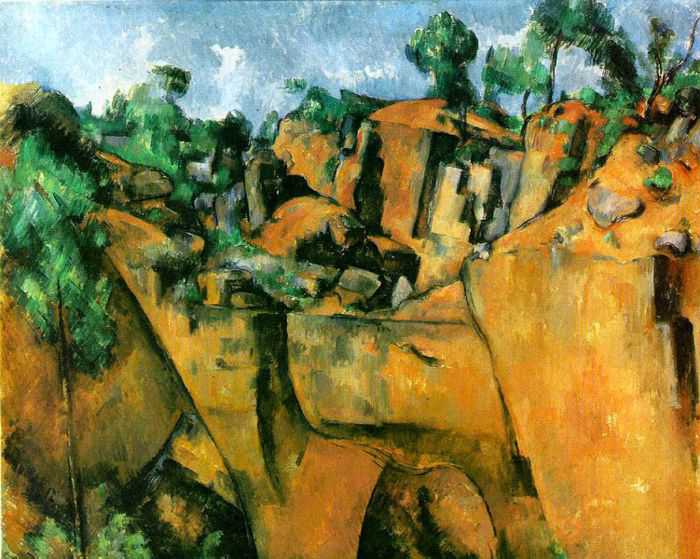
PAUL CÉZANNE (1839-1906)
'Bibemus Quarry', 1895 (oil on canvas)
'Bibemus Quarry', 1895 (oil on canvas)
http://www.artyfactory.com/art_appreciation/art_movements/cubism.htm (accessed: 14/10/16)
Modernism was a reaction of Victorian morality. Avant Garde was the term used depicting the type of artworks which was established against the norms of 'Art'. There was a far greater focus on one's consciousness and their lived experience.
Forms and structures reflected self, one's consciousness moving away from a particular subject matter. The Artist was then not only a preserver of culture and the time, but had a message or a story to tell. Sometimes, angry and political.
Storytelling in film began moving towards subjectivism, and had more of a focus on psychology. Self Reflexivity was a strong element which occurs in modernist films. This is where piece of work puts emphasis on itself. For example, in a film, the viewer is very aware of the fact they are watching a film. Emphasis may be put on the techniques and construction of the film. It calls to the audience to reflect on the design and structure of the film. An example of this could be where the main character looks directly into the camera, as if at the audience. We are then very aware of the existence of the character. Or, another example could be a film about making a film.
https://mubi.com/lists/self-reflecting-films
http://www89.homepage.villanova.edu/elana.starr/pages/selfreflexivity.htm (accessed: 14/10/16)
Define Reflexive - Looking back at one's self.
Modernist storytelling follows a non-linear narrative. This is prominent in both Postmodern and Modernist periods. Stories come away from the omniscient point of view (all knowing, third person/ God) and focus more on subjectivism. (That there is no meaning in such, or any external truth. There is no firm believe in anything.)
I myself tend to lean away from these kinds of narratives because I find them detached and chilling, while interesting, I am not as engrossed or involved emotionally with this type of film. It is indeed subjective. It is what it is. It looks at one subject with distance, and no meaning. I feel as though I watching an art form. A similar difference between fine art and illustration. It is there to serve it's own purpose and to exist for itself.
Before WW1
Russia's Eisenstein- a soviet film creator and film theorist looked at montage.
Thursday, 29 September 2016
Week 1 Classical Narrative
What is a story?
"A chain of events in cause-effect relationship occurring in time and space."
BORDWELL,D
& THOMPSON,K (2004) Film
Art –An Introduction
New York McGraw-Hill Companies,Inc
Within film there is always a cause and effect. The cause catapults into the effect which is quite a powerful and effective idea which is often embedded in classic narrative. For example, there is often consequence from a character’s actions.
Aristotle - Greek Master in Drama. Responsible for Greek Tragedy. Drama can be comedic or tragic. Considered the highest form of drama- he invented 6 kinds of genres or elements which can be recognised within film today.
Plot
The events of the story and not so much the theme. These are the events which happen within the narrative. It is easy to get confused with a theme, for example hunger was the driving force in the student animation we watched.
Theme
It is the underlying glue of a good story. This drives the plot, its purpose to communicate with the audience. Often themes can capture empathy from the audience with things such as hunger and greed.
Character
This is the driving force of the narrative. There are certain traits in which the character will have that the audience will relate to and be able to follow. The character is what lives within that cause-effect structure that a story is built upon. As often a character's actions, or simply existing within that cause triggers an event which is then a journey for them to travel.
Characters have traits which guide the audience how to feel about the characters and to indentify them without the plot. Conflict can emerge from interactions with other characters or trying to achieve goals once again falling into the category of that cause-effect theory.
Types of Character
Dynamic - Fully fledged
Stanislavski (acting theory) putting yourself inside a character. Where on the other hand, Brecht, distanced himself from the characters not descending into sentimentality.
(Remember, the animator is also the actor!)
Character - Static - Unchangeable
Stereotype - can be useful for short quick reactions. This suits comedy and satire.
Ironic - Could start as a good character and later revealed to be not so good.
Satiric??
Diction/Language/Dialogue
Rythym / Music
Construction across time, the pace whih holds the viewers interest.
Spectacle
The visual elements such as scenery and aesthetics of the scene.
Form and Genre
Form and Genre govern the shape of the narrative.
Genres are a definitive formula and have different ways of unravelling the narrative.
Action: This genre is fast paced and often considered 'over-the-top' or exaggerated. it is often quest driven, full of excitement and adrenaline.
Western - Oldest enduring American Genre depicting stories of settlers, land quests and ownership of said land.
Comedies are designed to achieve laughter. It is essential the timing is correct to build suspense to the answer of that cause-effect.
Crime / Gangster - The viewer gets to feel catharsis through tension and then release. These films are a fascination with wrong acts such as death, murder and crime. Often these are depicted as film noir or murder mysteries.
Drama is associated around realistic characters and events in which the audience easily relates to. Drama is often strung together with catharsis.
Timing is really important for building a narrative.
Within a three stage element process, a director or animator can build up an event, for example a joke and then suspend the answer. Once given, the audience should laugh, often we knew when to laugh. This is used often in comedy. The timing is essential for getting the audience to laugh. The two student videos we watched followed this very well. Like the warner bros animations, we know this type of archetypal character very well: the foolish coyote - roadrunner type and relationship, focusing on the theme of hunger. I knew that something comedic and bad- perhaps painful, would happen to the main character and so through suspecting, the audience already knows on cue when to laugh.
Catharsis - The process of release and thereby providing relief, strong or repressed emotions. It means purge, purification and recently, ‘intellectual clarification’. in drama we become attached to the character, we empathise with them through pity, fear and other emotions. For example, Aristotle believed that the audience had to have certain emotional responses to be necessary for a good tragedy. They had to have this release of emotion so they could then release that emotion.
According to Charles B. Daniels and Sam Scully on Aristotle’s view of cathasis (1992: 205-206) “To seek to have the negative emotions of pity and fear so one can then have a catharsis and be free of them is like knocking one’s head against the wall in order to have the subsequent relief of ceasing to do so.” I thought this was a really interesting quote as us psychologically as humans, viewing some film genres now seems quite masochistic. Why do we do it?
Reflexivity - This is where you disrupt your audience’s belief in that character. Often used in political themes where you want the audience to learn something. It keeps their attention and they become very aware and unable to escape of the fact they are watching a film.
Cathy Slim said that the theory of catharsis and reflexivity may be an interesting subject to study. Something to look at, at a later date would be Bertolt Brecht and his ideas around Reflexive drama.
Form defines the shapes of the film, the way the elements are organised and operate within the plot. It can also be about the way it looks. For example, how the lighting and colour controls the shapes of pictures we are viewing. For example dark lighting can give us an eerie setting. For shapes our viewing and reading of the content. It really important that as filmmakers we need to be able to talk about what form our films will take. Especially if we are pitching our ideas to a company, we will need to be able to put this into a language they will understand.
Visual form is fundamental to the creation of characters within the film. Without characters a narrative would have no structure or base. Characters can be built and exaggerated, through personality and design- which is why we have character designers. Anthromorphisism is where non human objects or animals have human characteristics. For example, Mickey Mouse is a bipedal character who wears clothes.
Types of Narrative
Narratology refers to the study of narrative; the way that the story is told. Inevitably, the viewpoint of the creator.
Linear narrative is straight forward and chronological to the end.
Linear narrative is straight forward and chronological to the end.
Non Linear.
Cyclic Linear
Interactive (For example game)
Non Linear Fact based - (associational, rhetorical, abstract, categorical)
Bordwell and Thompson insist that the human mind craves form, and how we experience is patterned and structured.
Narrator Position & Voice
The narrator will be either overt or covert.
Objective
Ominiscent narrative: All seeing, all knowing, paranomic- seeing all angles, often used for epics, fairy tales and historical film narrative. Often multiple characters are used so there is no particular point of view or focus on a particular character.
Heterodiegetic Narrative
This means multiple narratives so the viewer is naturally more detached emotionally to individuals.
Subjective
Often using optical shots to create a first person view, subjective narration is where we see events from the main character's point of view. We experience his or her life, experience flashbacks and thoughts. This can serve as a point or cue for the audience to predict events. This is a great platform for keep the audience focused and interested in the plot as they are interacting by pondering throughout.
Homodiegetic Narrative
This is seen through one person's view.
Ominiscent narrative: All seeing, all knowing, paranomic- seeing all angles, often used for epics, fairy tales and historical film narrative. Often multiple characters are used so there is no particular point of view or focus on a particular character.
Heterodiegetic Narrative
This means multiple narratives so the viewer is naturally more detached emotionally to individuals.
Subjective
Often using optical shots to create a first person view, subjective narration is where we see events from the main character's point of view. We experience his or her life, experience flashbacks and thoughts. This can serve as a point or cue for the audience to predict events. This is a great platform for keep the audience focused and interested in the plot as they are interacting by pondering throughout.
Homodiegetic Narrative
This is seen through one person's view.
These qualities of narrative can influence and manipulate the perception of the audience and evoke certain reactions. For example, through first person, a horror scene may be more intimidating.
The narrator authors opinions. It is worth keeping in mind that the Narrator position for a film maker becomes subjective as unlike a book author, your opinion cannot shine through by simply framing the shot. Many books are also like this and written in third person, where the creator is the God of the world created. The narrative creates a voice which creates a relationship between the audience and creator as inevitably your creation will show some of your point of view as all stories are to guide the audience to the same conclusion.
Point of View - Relationship between the film Maker and the Audience
(Think about the audience, rather than creating ‘Art films’ by remembering your target audience and what content you require to hit that audience. )
Subjective - Starting in the 1940s, playing with language and emotional content.
Restrictive narration - Withholds information and builds suspense. This is very good for surprising and shocking your audience at the end when you reveal the information suddenly.
Ominiscent Narrative - This narrative relates to all. For example, the viewers may know something that the main character does not. The audience can become very involved by for example wanting to prevent something bad from happening to the main character if they are 'all knowing' along with the creator and narrator.
Ominiscent Narrative - This narrative relates to all. For example, the viewers may know something that the main character does not. The audience can become very involved by for example wanting to prevent something bad from happening to the main character if they are 'all knowing' along with the creator and narrator.
The classic Narrative -
Establishes the situation
Introduces a problem
Then, there will be a resolution.
Pre-modern Literature
Reality seen Externally
Central character
Lineart Narrative
Early 20th Century Cinema -Beginning - Middle (Point of tension) and then the end.
Hero - Someone good. Omniscient view (all knowing.)
Gustav Freytag - Analysing drama and film and making sure film structure will work
Subscribe to:
Comments (Atom)