Sunday, 23 October 2016

Saturday, 22 October 2016
References
- Appignanesi, R., Garratt, C., Sardar, Z. & Curry, P. 2004, Introducing postmodernism, [New] edn, Icon, Thriplow.
Friday, 14 October 2016
Week 2 Modernist Narrative
Modernism crosses over all creative approaches, from film, to art to literature. As science was developing, along with urbanisation and industrialisation, people also began to change. they began to question their undoubted belief in God and Religion which had been deeply set by the Catholic Church and their lack of religion. Characters such as Freud and Darwin began challening intellectual hegemony (leader or dominance over social groups, and all of the values that were the foundations of these very people's lives.
The Industrial Revolution was where huge populations move to cities where there then had access to education.
The invention of photography had an enormous effect on the approach people had to art. Many new forms of Art and 'isms' such as 'Cubism,' and 'Surrealism' were established. The cubist movement featured painters who tried to capture many perspectives such as Cezanne. He tried in a more honest way to visualise objects in a 3D distortions.

The Industrial Revolution was where huge populations move to cities where there then had access to education.
The invention of photography had an enormous effect on the approach people had to art. Many new forms of Art and 'isms' such as 'Cubism,' and 'Surrealism' were established. The cubist movement featured painters who tried to capture many perspectives such as Cezanne. He tried in a more honest way to visualise objects in a 3D distortions.
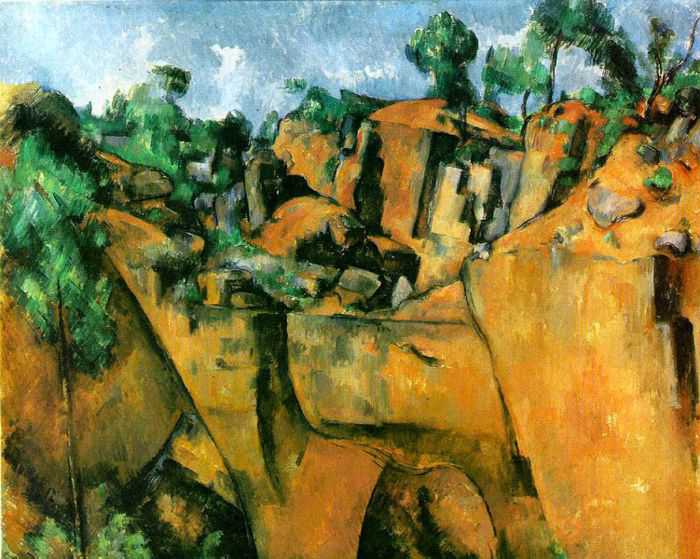
PAUL CÉZANNE (1839-1906)
'Bibemus Quarry', 1895 (oil on canvas)
'Bibemus Quarry', 1895 (oil on canvas)
http://www.artyfactory.com/art_appreciation/art_movements/cubism.htm (accessed: 14/10/16)
Modernism was a reaction of Victorian morality. Avant Garde was the term used depicting the type of artworks which was established against the norms of 'Art'. There was a far greater focus on one's consciousness and their lived experience.
Forms and structures reflected self, one's consciousness moving away from a particular subject matter. The Artist was then not only a preserver of culture and the time, but had a message or a story to tell. Sometimes, angry and political.
Storytelling in film began moving towards subjectivism, and had more of a focus on psychology. Self Reflexivity was a strong element which occurs in modernist films. This is where piece of work puts emphasis on itself. For example, in a film, the viewer is very aware of the fact they are watching a film. Emphasis may be put on the techniques and construction of the film. It calls to the audience to reflect on the design and structure of the film. An example of this could be where the main character looks directly into the camera, as if at the audience. We are then very aware of the existence of the character. Or, another example could be a film about making a film.
https://mubi.com/lists/self-reflecting-films
http://www89.homepage.villanova.edu/elana.starr/pages/selfreflexivity.htm (accessed: 14/10/16)
Define Reflexive - Looking back at one's self.
Modernist storytelling follows a non-linear narrative. This is prominent in both Postmodern and Modernist periods. Stories come away from the omniscient point of view (all knowing, third person/ God) and focus more on subjectivism. (That there is no meaning in such, or any external truth. There is no firm believe in anything.)
I myself tend to lean away from these kinds of narratives because I find them detached and chilling, while interesting, I am not as engrossed or involved emotionally with this type of film. It is indeed subjective. It is what it is. It looks at one subject with distance, and no meaning. I feel as though I watching an art form. A similar difference between fine art and illustration. It is there to serve it's own purpose and to exist for itself.
Before WW1
Russia's Eisenstein- a soviet film creator and film theorist looked at montage.
Subscribe to:
Comments (Atom)